


Knee or Hip Replacement Abroad: How Long Are Patients in the UK and Canada Waiting?

Once a diagnosis is confirmed, one might assume that only a date for surgery remains to be set. In practice, the situation is often quite different. For many patients in the United Kingdom and Canada, the wait for a knee or hip replacement extends over many months, and in some cases exceeds a year.
Waiting lists for elective joint replacement remain one of the most persistent challenges facing public healthcare systems. While patients wait, pain intensifies, mobility declines, and quality of life deteriorates progressively.
This article examines current waiting times for joint replacement surgery, the reasons these waiting lists remain so long, and the alternatives increasingly considered by patients who are unwilling to delay treatment for another year.
How Long Is the Wait for a Knee or Hip Replacement in the UK (NHS)?
According to NHS data, 7.12 million patients were on the waiting list for planned treatment as of February 2026 — a figure that illustrates the scale of pressure on the UK healthcare system.
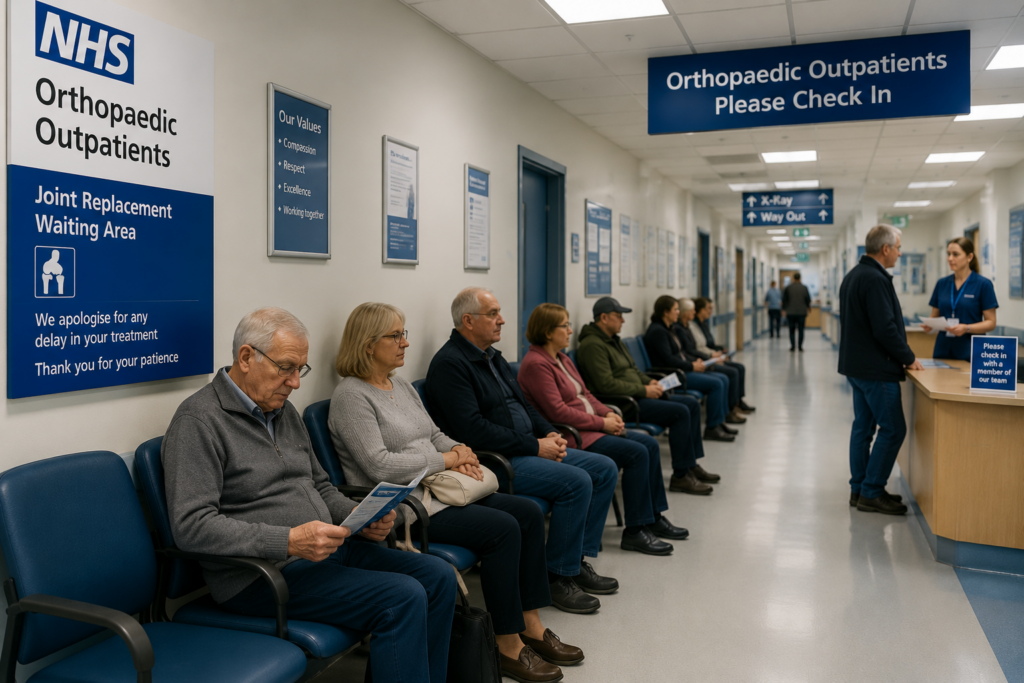
The NHS target is to begin treatment within 18 weeks of referral. Currently, however, this target is met for only approximately 62.5% of patients, against a stated goal of 92%.
The median waiting time across the system is 12.4 weeks, though this figure does not reflect the situation in individual specialties. Orthopaedics remains one of the most overburdened areas of medicine: official statistics indicate that approximately 105,000 patients are waiting more than a year for planned surgery.
Knee and hip replacement procedures are particularly affected. An ageing population, rising rates of osteoarthritis, and constrained NHS capacity mean that the joint replacement waiting list continues to grow faster than the system can reduce it.
Source: Nuffield Trust / King’s Fund, 2026
How Long Is the Wait for Joint Replacement Surgery in Canada?
Canada’s healthcare system faces comparable difficulties.
According to the Fraser Institute, the median waiting time for orthopaedic treatment — from referral by a family physician to surgery — is 48.6 weeks. This amounts to nearly a full year for patients requiring a knee or hip replacement.
Data from the Canadian Institute for Health Information (CIHI) points to a related concern: only 61% of patients receive a knee replacement within the recommended benchmark of 26 weeks. Before the pandemic, this figure stood at approximately 70%, and the system has not yet fully returned to its previous pace.
Canada performs approximately 75,000 knee replacement procedures annually, yet demand continues to outpace the capacity of healthcare institutions.
Waiting times also vary considerably between provinces: in some regions they are close to the national average, while in others they significantly exceed it.
Sources: Fraser Institute, «Waiting Your Turn 2025»; Canadian Institute for Health Information (CIHI)
Why Do Waiting Lists Continue to Grow?
For a patient who has lived with persistent pain for several months, the underlying causes of long waiting lists may seem of secondary importance. They nonetheless explain why the problem persists, in both the UK and Canada.
The principal factor is population ageing. Individuals over the age of 60 are most likely to require a knee or hip replacement, and the prevalence of osteoarthritis increases with age, driving demand for surgical treatment accordingly.
At the same time, both healthcare systems face shortages of operating theatres, anaesthetists, orthopaedic surgeons, and nursing staff. The effects of the COVID-19 pandemic have compounded this pressure: thousands of operations postponed in 2020-2021 continue to affect clinic capacity today.
As a result, demand for joint replacement surgery continues to grow faster than public healthcare systems are able to expand their capacity. While the situation is gradually improving, waiting times remain considerable.
Private Surgery at Home, or Treatment Abroad?
When waiting times extend to many months, most patients begin to consider alternative options. The choice generally comes down to one of two paths:
- surgery at a private clinic in one’s home country
- treatment arranged abroad

Private joint replacement in the UK or Canada allows patients to avoid the waiting list, though the cost is often substantial — frequently tens of thousands of pounds or Canadian dollars, depending on the clinic, the surgeon’s qualifications, the type of implant, and the length of hospitalisation.
Treatment abroad is frequently more affordable while also allowing significantly faster access to surgery. It also allows the patient to select the clinic, surgeon, and rehabilitation programme in advance.
Patients are not required to navigate an unfamiliar foreign healthcare system independently. A medical coordinator manages the organisation of treatment, communication with the clinic, preparation of documentation, and support throughout the journey.
Countries Offering Faster Access to Knee or Hip Replacement
Patients from the UK and Canada are increasingly choosing treatment abroad, motivated not only by cost but by a wish to regain their previous quality of life without prolonged delay. We work with clinics in several countries, each suited to different priorities — from cost-effective solutions to robotic-assisted surgery and established European university hospitals. The choice of country is determined not by price alone, but by the specifics of the individual case, the patient’s preferences, and the recommendation of the Hospitality MedService medical board.

Türkiye
In recent years, Türkiye has become one of the most popular medical tourism destinations for UK residents, now ranking among the top six such destinations. In 2025, more than 500,000 UK residents travelled abroad for treatment, with joint replacement among the most frequently sought procedures.
We work with the Turan & Turan group of orthopaedic clinics in Bursa. It was here, in 2016, that Türkiye’s first robotic-assisted knee replacement was performed, followed two years later by the introduction of the same technology for hip replacement.
The clinic’s founder, Dr Kayhan Turan, has personally performed more than 2,000 robotic-assisted procedures, and the clinic’s surgical team has carried out over 11,000 joint replacement operations in total.
For patients, this represents not only extensive surgical experience but access to technology that remains limited in availability within NHS and Canadian public hospitals.
Czech Republic
The Czech Republic is well suited to patients seeking treatment to European standards without the cost associated with private care in the UK.
Surgery here typically costs 40-60% less than in a British private clinic, while maintaining the same standards of safety and quality of care.
Our partner clinic, Malvazinky Clinic in Prague, offers a complete treatment pathway at a single facility: pre-operative assessment, surgery, and rehabilitation all take place without the need to transfer between institutions.
The orthopaedic department is led by Dr Vladislav Hospodář, who has practised joint surgery since 1989. In addition to his clinical work, he has served as team physician for the Czech national ice hockey team at the Winter Olympic Games.
India
For patients whose principal consideration is achieving the most favourable balance of cost and quality, India is frequently the country of choice.
We partner with the flagship hospital of the Apollo Hospitals group in Chennai, the site where India’s largest private hospital network was established in 1983 and which today comprises more than 70 hospitals.
The clinic is recognised as one of the pioneers of total joint replacement in India. According to the clinic’s own data, success rates for hip replacement surgery reach nearly 99%.
Lead orthopaedic surgeon Dr Gopala Krishnan has practised for more than forty years and is the author of over 150 scientific publications and conference presentations.
For many international patients, this combination of extensive surgical experience and affordable pricing makes India a compelling option.
Germany
Some patients place greater weight on institutional reputation and academic medicine than on cost. For such patients, Germany is generally the appropriate choice.
We work with leading university hospitals in Germany, including Charité and University Hospital Freiburg. These institutions have extensive experience managing complex orthopaedic cases, follow current international protocols, and offer a comprehensive approach encompassing detailed diagnostics and an individualised post-operative recovery programme.
Treatment costs here are higher than in most other countries; however, many patients select German clinics specifically for their long-established reputation and consistently predictable outcomes.
Why Do Patients Choose Robotic-Assisted Joint Replacement?
When selecting a clinic, patients increasingly consider not only the surgeon’s experience but also the technology used during the procedure, with robotic-assisted joint replacement receiving particular attention.
It is important to clarify the role of the robotic system: the operation is performed by the surgeon, while the robotic system functions as a highly precise instrument that assists in planning the procedure according to the patient’s individual anatomy and in positioning the implant with greater accuracy. This approach improves the precision of component placement and provides the surgeon with additional control at each stage of the operation.
Public hospitals in the UK and Canada currently make limited use of this technology.
Our partner clinics have adopted it more widely. Turan & Turan, for example, was the first clinic in Turkey to introduce robotic-assisted technology for joint replacement, and now applies the same technology to spinal surgery. Apollo Hospitals in Chennai is similarly regarded as a pioneer of robotic spinal surgery in Asia.
Patients for whom a robotic-assisted procedure is a specific priority should inform their coordinator at the initial consultation, so that a clinic where this technology is genuinely applicable to their case can be identified.
The Treatment Organisation Process at Hospitality MedService
Hospitality MedService does not provide medical care directly. Our role is to organise treatment abroad so that patients can focus on their recovery rather than the associated logistics.
Review of medical documentation
Following initial contact, we review the available medical documentation — physicians’ reports, test results, and CT or MRI scans. Each case is assessed by our medical board, which identifies the clinics most appropriate to the patient’s particular situation.
Selection of clinic and surgeon
We take into account the patient’s priorities, including the required timeframe for surgery, budget, preferred country of treatment, interest in robotic-assisted procedures, rehabilitation requirements, and any other considerations. The treatment plan is then agreed directly with the clinic.

Arrangement of travel
We manage all aspects of the journey, including:
- communication with the clinic
- assistance with documentation
- visa support, where required
- accommodation booking
- transfer and logistics arrangements
Support during treatment
The coordinator remains in contact throughout treatment, assisting with any matters that arise from departure through to return home.
Post-operative support
Where required, support continues following discharge, including assistance with arranging rehabilitation, follow-up consultations, or ongoing monitoring.
Frequently Asked Questions
Yes. The referral letter contains relevant medical information that allows the overseas clinic to assess the case more efficiently. The coordinator will advise on how best to use existing documentation during the initial consultation.
This depends on the specific province and the terms of the insurance plan in question. There is no universal answer, and patients are advised to confirm coverage with their insurer before making a decision. We cover how insurance coverage for treatment abroad actually works for patients from the UK, US, Canada, and the EU in a separate article.
In most cases, a knee or hip replacement requires approximately two weeks abroad. Where full rehabilitation is undertaken at the clinic, the length of stay may extend to as much as six weeks.
This is a common circumstance. In discussions with the clinic, complete and current information regarding all diagnoses is provided, allowing the medical team to account for every relevant factor during treatment planning.
This is a matter of individual preference. Some patients prefer to travel with a family member, while others manage independently, particularly when the trip is well organised. Arrangements are made according to the patient’s wishes to ensure comfort and confidence throughout.
Timelines depend largely on entry requirements for the destination country and whether the patient holds a valid visa. In most cases, travel for surgery can be arranged within a matter of days. A realistic timeline is provided by the coordinator following review of the case by our medical board.
A Delayed Return to an Active Life Is Not Inevitable
When waiting times through the NHS or the Canadian healthcare system extend to many months, this need not mean continuing to live with pain and restricted mobility.

We assist in identifying an appropriate clinic, comparing treatment options, arranging consultations with surgeons abroad, and managing all aspects of the journey.
Leave a request, and a Hospitality MedService medical coordinator will review your case at no charge, outline the available treatment options abroad, and help identify the solution best suited to your circumstances.
Hospitality Medservice: Your Trusted Partner in Finding the Best Clinics Worldwide. Our website features only reputable medical institutions equipped with the latest treatment protocols and technologies. Compare clinics, meet doctors, and review treatment costs. Contact us for assistance with:
- Arranging treatment trips
- In-person appointments
- Video consultations
- Obtaining a “second opinion”
Submit a request on our website, and our medical coordinator will contact you promptly.
Leave a request for a free consultation.
A coordinator will contact you as soon as possible

Text reviewed

Read also:
*Illustrations in this article are created using artificial intelligence and are for illustrative purposes only. These images are not photographs of specific clinics, doctors, or patients, but are used to visually represent the procedures and treatment areas described.