


Second Opinion on Cancer Treatment Abroad: When to Seek One and How to Get It

You have a diagnosis and a treatment plan, but questions remain. Was everything taken into account when the diagnosis was made? Is the proposed plan the right one? Are there options nobody has mentioned?
This is when a second opinion on your cancer from an oncologist abroad can help. An independent specialist who works with your type of cancer reviews your medical records and the proposed treatment plan. You don’t need to travel: the doctor can write a report based on your records or speak with you by video.
When to consider a second opinion
You can ask for a second opinion at any stage of the illness. It is especially worth considering if:
- the tumor is rare or complex, and few specialists see cases like yours;
- the diagnosis is uncertain: the pathology report is inconclusive, or test results contradict each other;
- you’ve been offered major surgery, removal of an organ, or treatment with serious side effects;
- different doctors have already given you different recommendations;
- treatment isn’t working as expected;
- you want to know whether newer treatments or clinical trials could suit you.
If the patient is a child, it is especially important to find a center that regularly treats that diagnosis. Learn more on our Pediatric Oncology page.
How a second opinion can affect your treatment
In cancer care, the stakes of every decision are high. The choice of treatment depends on an accurate diagnosis, the stage and the biology of the tumor. Sometimes it also decides whether an organ can be saved or a more extensive operation avoided. Even experienced specialists can read a complex case differently: a lot depends on their focus, their experience with a particular tumor type and what their hospital can offer. A doctor who treats your condition every day can look at your case from a different angle and tell you whether there are proven options that haven’t been discussed yet.
How often does a second opinion change the recommendations? Researchers at Memorial Sloan Kettering Cancer Center in New York looked into this. In a study published in Cancer Medicine in 2023, they reviewed 120 cases in four disease groups: colorectal cancer, head and neck cancers, lung cancer and multiple myeloma. They found that:
- in 35% of cases, the second opinion led to changes in treatment that the researchers rated as potentially clinically significant and beneficial;
- in 11% of cases, the diagnosis changed, and the treatment changed with it (these cases are part of the 35%);
- in 63% of cases, the second opinion had no significant effect on treatment;
- in 2 of the 120 cases, the expected effect of the changes was rated as negative.
So in more than one in three cases, the second opinion led to changes the researchers considered potentially important. That doesn’t mean 35% of patients had been treated wrongly. The study was retrospective, took place at a single center and covered only four disease groups. Still, it shows that an independent review sometimes changes what happens next. And if the original recommendations are confirmed, you have stronger grounds to go ahead with the plan.
How a remote second opinion works
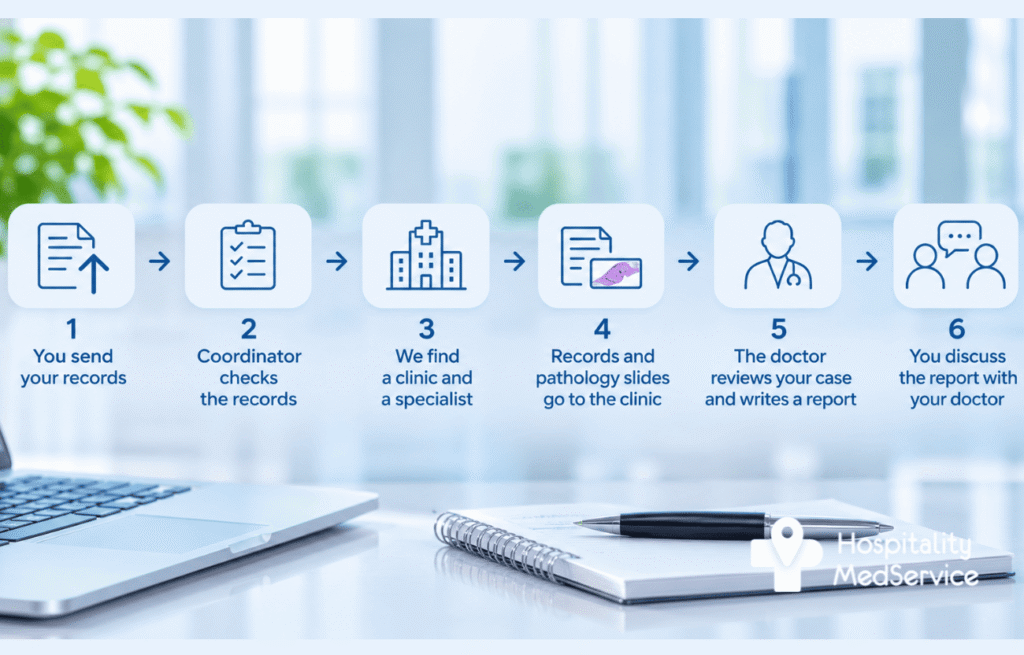
You don’t need to travel: your records are sent to the clinic remotely, and an HMS coordinator handles every step. Here’s how it works:
- You send a request and whatever records you already have.
- The coordinator checks them and tells you what’s missing.
- We find a clinic and a specialist for your diagnosis and agree the clinic’s fee with you.
- Your records go to the clinic. If the specialist asks for them, your pathology slides and tissue blocks are sent too.
- A doctor or the clinic’s tumor board writes a report or holds a video consultation, depending on the clinic.
- You discuss the results with your own doctor.
If you decide to continue treatment abroad after receiving the report, HMS can help arrange the trip and related services.
How long it takes
| Country | Turnaround, business days |
| Germany, Italy, Spain | 2-7 |
| China | 2-7 |
| Israel | 5-8 |
| South Korea | 7-12 |
| Japan | 7-12 |
| USA | 10-12 |
The clock starts once the clinic has received payment and a complete set of records. It may take longer if the specialist needs to re-examine pathology slides or imaging, asks for additional tests, or has to wait for samples to arrive.
What medical records to prepare
The doctor needs to see the whole history of your illness, not just the latest report. The more complete your records, the better the specialist can understand your case, and the less likely the clinic is to come back asking for more.
A typical list of records for a remote consultation with an oncologist abroad:
- discharge summaries and doctors’ reports;
- the pathology report and immunohistochemistry (IHC) results, which help pin down the tumor type;
- molecular and genetic test results, if you’ve had them;
- CT, MRI and PET-CT scans: the images themselves in DICOM format (the files you get on a disc or via a download link) and the radiologist’s reports;
- operative reports, if you’ve had surgery;
- details of treatment so far and how the tumor responded;
- a list of the medicines you take now;
- a one-page timeline of your illness: when symptoms started, which tests and treatments you’ve had;
- 3-5 specific questions for the doctor, such as “Do you agree with the diagnosis?”, “Is there an alternative to surgery?” or “Do I need any more tests?”
If your records aren’t in English, they will usually need translating into English or the clinic’s language. Requirements vary by country and clinic, so it’s best to check in advance. HMS arranges medical translation to the clinic’s requirements.
Pathology review: when slides and blocks are needed
A pathology report describes what was found when your tissue sample was examined. Sometimes the report alone is enough for a second opinion. But if the diagnosis needs clarifying or the results raise questions, the pathologist abroad may ask for the material itself: glass slides with thin sections of tissue, and the paraffin blocks that hold the sample and from which new sections can be cut.

Samples are usually shipped by courier, so allow extra time to arrange shipment and delivery. After examining the material, the clinic may recommend additional stains or tests, which are charged separately.
Not sure your records are complete? Send what you have, and a coordinator will tell you what’s missing.
How to choose where to send your records
When choosing a clinic abroad, check that its specialists have experience with your diagnosis. A few things to look at:
Specialization in your tumor type. A doctor who treats breast cancer every day is more likely to spot the subtleties than a general oncologist.
Tumor board review. For complex cases, ask whether a multidisciplinary team will review your records. It may include a surgeon, a medical oncologist, a radiation oncologist, a pathologist and a radiologist. Looking at a case together brings several professional perspectives at once.
Format. A written report, or a video consultation where you can ask questions.
Language and timing. What language the report will be in and how long you’ll wait.
What comes next. If you’re open to treatment abroad, it helps if the clinic giving the second opinion is one where you could later be treated.
For more on choosing a clinic, see our article How to Choose a Clinic Abroad: A Checklist for Patients.
Where you can get a second opinion
Below are examples of clinics in different countries where HMS arranges second opinions for international patients. The list isn’t exhaustive: HMS can arrange a review at many other clinics too. The coordinator picks the best fit based on your diagnosis, the doctor’s specialty and what the clinic can offer.
-

 Freiburg, Germany
University Hospital of Freiburg
-
 Hamburg, Germany
Asklepios Nord Heidberg
-

 Milan, Italy
San Raffaele University Hospital
-

 Barcelona, Spain
Medical Center Teknon
-

 Ramat Gan, Israel
Sheba clinic
-
 Jerusalem, Israel
Hadassah Medical Center
-
 Petah Tikva, Israel
Schneider Children's Medical Center
-

 Ohio, USA
Cleveland Clinic Medical Center
-
 California, USA
Ronald Reagan UCLA Medical Center
-

 Seoul, South Korea
Asan Medical Center
-
 Seoul, South Korea
Samsung Medical Center
-
 Seoul, South Korea
SNUH
-
 Seoul, South Korea
Medical Center at Ewha Womans University
-

 Tianjin, China
BIOOCUS Cancer Cell and Gene Therapy Medical Center
-

 Tokyo, Japan
Teikyo University Hospital
-
 Tokyo, Japan
Japanese Red Cross Medical Center
Japanese hospitals generally accept requests from international patients through a coordinator and may require medical records to be translated into Japanese.
TOP doctors in global medicine
-
 Doctor Robert Thimme
Gastroenterologist
-
 Doctor Paul Kremer
Brain and spinal cord tumor specialist
-
 Doctor Giampaolo Bianchini
Immunotherapy specialist
-
 Doctor Alon Pikarsky
Specialist in colorectal surgery and treatment of gastrointestinal tumors
-
 Professor Liang Han
Oncologist
-
 Doctor Kazunori Nagasaka
Oncogynecologist
How much a remote cancer second opinion costs
The cost has two separate parts: the HMS coordination fee and the clinic’s bill. Both are agreed before any work begins.
HMS coordination fee: €400. This covers choosing the clinic and specialist, checking your records, preparing and sending them, and support until you receive the report.
The clinic bills separately for the consultation. The amount depends on the clinic, the specialist and the scope of the work, for example whether pathology or imaging has to be re-reviewed. Any translation or courier costs are also agreed in advance. HMS doesn’t add any markup to the clinic’s fee.
As a guide, a consultation at Cleveland Clinic (USA) starts at $1,300, and at an Italian university hospital from €350. These are starting prices and may change; the clinic confirms the exact fee before the review begins.
Will insurance pay for it?
Coverage depends on your country of residence, your insurer and the terms of your policy.
UK. You can ask your consultant or GP whether a referral for another opinion is appropriate. The NHS does not routinely arrange or fund every second-opinion request, and access may depend on your clinical circumstances and local arrangements (Macmillan Cancer Support). A second opinion from a clinic abroad is generally paid for privately or through private medical insurance. Check with your insurer before making an appointment.
USA. You can seek another medical opinion, but insurance coverage depends on your plan, medical necessity rules and whether the provider is in network (Triage Cancer). Medicare Part B covers a second opinion before medically necessary, non-emergency surgery (Medicare.gov). This benefit does not automatically cover remote oncology reviews or consultations at clinics outside the United States. Check your plan’s rules before proceeding.
International and expat health plans. Some policies include access to a medical second-opinion service. Check whether the benefit covers oncology reviews, providers outside your country of residence and independent clinics abroad. Ask your insurer for confirmation before you start.
For more on cover, see our article Will Insurance Cover Treatment Abroad?
What an oncologist can and can’t assess from your records
From your records, a doctor abroad can answer questions such as:
- whether the diagnosis matches the available data;
- whether you’ve had enough tests or need more;
- what stage the cancer is, as far as the records allow;
- whether the proposed treatment plan is well founded and whether there are alternatives;
- whether there are clinical trials worth considering.
Not every question can be answered remotely. What the specialist can say depends on the diagnosis and on how complete and clear your records are.
A remote review has limits. The doctor doesn’t examine you and can’t assess some signs that only show up in person. A report based on records doesn’t replace care from your own doctor, and the specialist who wrote it doesn’t automatically take over your treatment. If there isn’t enough information to answer a question, the report should say so and list what other information or tests are needed.
What to do if the second opinion differs from your doctor’s
If two specialists disagree, find out exactly where they differ and what each opinion is based on.
Step by step:
- Show the report to your doctor and ask them to talk through its reasoning. Asking for a second opinion is normal practice and doesn’t mean you distrust the doctor treating you.
- Find out exactly where they disagree: the diagnosis, the stage, or only the order of treatment. Sometimes the doctors agree on the essentials and differ on details.
- If they disagree about the diagnosis, the slides may need re-reviewing or an extra test may be needed. If they disagree about treatment, a tumor board can help.
- Remember that the decision is yours. The doctors’ job is to give you full information about your options and explain the pros and cons of each.
How HMS supports the process
HMS arranges second opinions and takes care of the organizational steps. Our physician coordinators check that your records are complete and coordinate the review with the clinic. Once the report arrives, a coordinator can explain its general meaning in plain language and help you prepare questions for your own doctor.
Medical and organizational roles stay separate, though. The medical opinion comes from a doctor or tumor board at the chosen clinic. HMS coordinators don’t interpret the findings in a clinical sense, assess treatment options or make treatment recommendations, and HMS doesn’t diagnose or prescribe treatment.
Our job is to get your records to the right specialists and help you work with the clinic, so that you get a complete and useful answer to discuss with your doctor.
Frequently Asked Questions
Asking for an independent review is common practice and doesn’t in itself signal distrust. You can simply explain that you want to understand your diagnosis and options better, then go through the report with your oncologist.
Yes. People ask for one after treatment has started too, for example if it isn’t working as expected or a decision about the next stage is coming up. Don’t change or stop your treatment without talking to your doctor.
Typical turnaround times by country are in the table above, though actual timing depends on the clinic and the scope of the review. If your condition needs urgent action, ask your doctor whether it’s safe to wait. Don’t delay or change your treatment on your own.
This depends on the clinic. If it offers a video consultation, you can put questions to the specialist directly, and an interpreter can be arranged in advance if needed.
No. A second opinion doesn’t commit you to anything. You can continue treatment at home, go to the clinic that gave the opinion, or choose another one.
Family members can help gather records and make the request. However, the clinic may ask for the patient’s consent to share and process their medical data. For a child, proof of parental responsibility or guardianship may be needed.
Sometimes. It depends on your country, insurer and policy; see “Will insurance pay for it?” above and confirm the benefit with your insurer.
The HMS coordination fee is €400. The clinic’s consultation is paid separately, and its fee is agreed before work starts. Pathology review, additional tests, translation and courier delivery may cost extra, and all such costs are discussed in advance.
No. The initial review of your medical records is usually done remotely.
Send the medical records you have. An HMS coordinator will check whether they’re enough and help arrange your second opinion.
This article is for informational purposes only and does not constitute medical advice. Hospitality MedService provides organizational and coordination services for patients working with medical centers abroad. HMS does not diagnose, prescribe treatment or provide independent medical opinions.
Hospitality Medservice: Your Trusted Partner in Finding the Best Clinics Worldwide. Our website features only reputable medical institutions equipped with the latest treatment protocols and technologies. Compare clinics, meet doctors, and review treatment costs. Contact us for assistance with:
- Arranging treatment trips
- In-person appointments
- Video consultations
- Obtaining a “second opinion”
Submit a request on our website, and our medical coordinator will contact you promptly.
Leave a request for a free consultation.
A coordinator will contact you as soon as possible

Text reviewed

Read also:
*Illustrations in this article are created using artificial intelligence and are for illustrative purposes only. These images are not photographs of specific clinics, doctors, or patients, but are used to visually represent the procedures and treatment areas described.