


IVF Abroad: When Fertility Treatment Is Restricted, Expensive or Unavailable at Home

Medical travel for infertility treatment is nothing new. According to a 2010 study coordinated across six European countries by the European Society of Human Reproduction and Embryology (ESHRE) (Shenfield et al.), somewhere between 24,000 and 30,000 cross-border fertility cycles were carried out in Europe each year, involving roughly 11,000-14,000 patients.
Europe remains one of the main destinations for treatment: according to ESHRE, 41 European countries reported 923,318 ART cycles in 2020 alone. Yet access to IVF varies considerably across Europe: what is permitted for one group of patients in Spain or Denmark may be unavailable in Czechia, Germany or Italy. Success rates differ as well.
Why Patients Choose IVF Abroad
Most patients who look into treatment abroad have more than one reason for doing so.
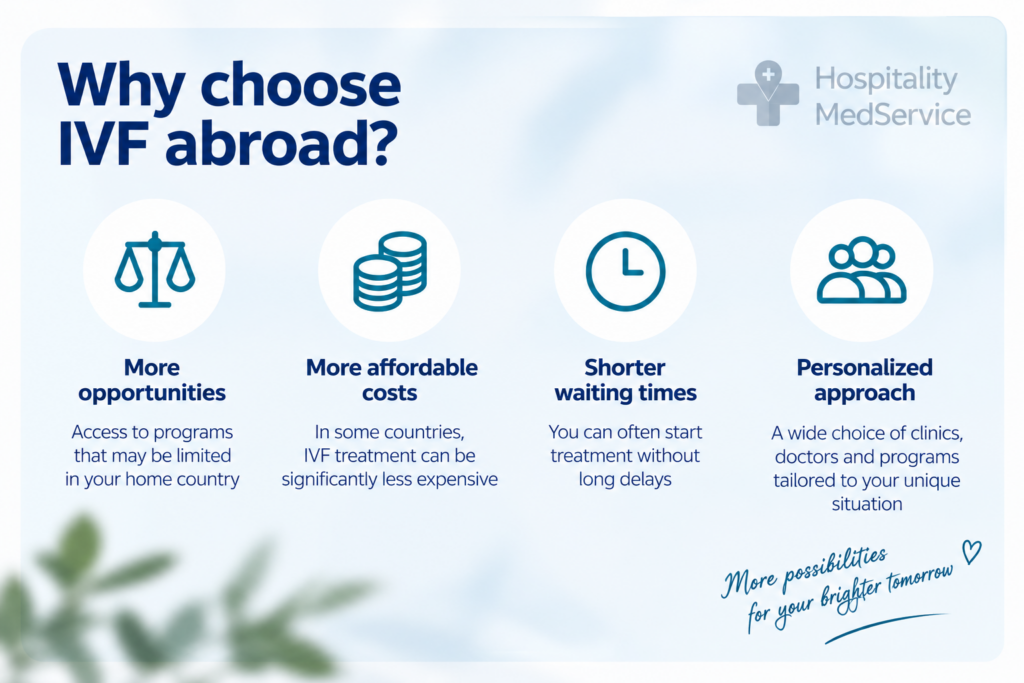
Legal restrictions. Some countries limit specific types of fertility care. Germany and Switzerland, for example, prohibit egg donation; Czechia only offers IVF to a female-male couple; and Italian law restricts donor programmes for single women.
Limited public funding. Even where IVF is part of the public health system, that doesn’t mean it’s fully covered. In the UK, for instance, the share of publicly funded cycles varies sharply from one region to another.
High cost of private treatment. For patients without public funding, the price of IVF can be the biggest obstacle — especially in the US, where a single cycle can run into the tens of thousands of dollars.
Waiting lists. In public systems, treatment can be delayed for months, and when donor material is involved, timing also depends on donor availability. The UK’s Human Fertilisation and Embryology Authority (HFEA) notes that some UK clinics have donor-egg waits exceeding six months.
Age criteria. Whether you can access IVF depends not just on your medical situation, but on legislation, public-funding rules and individual clinic policy — and age limits vary considerably between countries.
Unavailable donor programmes. A country may allow IVF broadly while still restricting donor eggs or sperm, treatment for single women, or donor identification rules.
So choosing treatment abroad is often less about finding the cheapest clinic and more about finding a programme that actually fits your situation. Below, we break down how rules, cost and access differ by country.
Where IVF Abroad Is Allowed, and What the Restrictions Are
There are two separate questions worth untangling here: “Is IVF legal in this country at all?” and “Who exactly is allowed to have it, and which methods are available?”
Rules differ for heterosexual couples, single women, same-sex couples, and patients who need donor eggs or sperm.
| Country | IVF Access and Key Restrictions |
| Spain | IVF and donor programmes are available to a wide range of patients, including single women |
| Czechia | IVF and donor programmes are available, but treatment is for a couple — a woman and a man; the country doesn’t suit every patient category |
| Portugal | IVF is available to single women and couples; donor programmes are permitted |
| Denmark | IVF and donor programmes are available to a wide range of patients; donor identification terms depend on the programme |
| UK | IVF and donor treatment are available; public funding is governed by separate regional criteria |
| France | Access to ART has been extended to single women and female couples since 2021 |
| Belgium | IVF and donor programmes are available; funding terms depend on programme criteria |
| Sweden | IVF with donor material has been available, including to single women, since 2016 |
| Netherlands | IVF and donor programmes are available under national regulation |
| Germany | Sperm donation is permitted; egg donation is prohibited by law |
| Switzerland | Egg donation is still prohibited; legislation is under review |
| Austria | Treatment currently requires marriage, registered partnership or cohabitation; following a Constitutional Court ruling, these provisions are set to end after 31 March 2027 |
| Norway | Access to donor eggs is limited; conditions depend on patient category and method |
| Italy | Access to IVF is restricted by law; single women are not among the patient categories with access to treatment |
| Poland | Donor gametes are permitted, but access to treatment is restricted by legal requirements |
Legislation in this area keeps shifting. In Switzerland, the Federal Council began preparing a reform in 2025 that would legalise egg donation — as of this article’s publication, it’s still working through the legislative process. In Austria, current restrictions are set to end after 31 March 2027 following a Constitutional Court ruling. Before planning treatment, it’s worth checking the current requirements of both the country and the specific clinic.
When IVF at Home Is Expensive or Comes With Restrictions
UK — the NHS Doesn’t Mean Free IVF
Access to NHS-funded IVF in the UK varies significantly by region. In 2024, the NHS funded 28% of IVF cycles across the UK as a whole, and just 25% in England. For comparison: Scotland funded 54%, Wales 35%, and Northern Ireland 50%. That’s where the phrase “postcode lottery” comes from — whether your treatment gets funded depends not just on your medical situation, but on where you happen to live.
If NHS-funded treatment isn’t an option, self-funded IVF is the alternative. For some UK patients looking at IVF abroad, treatment in another country becomes a way to find better value and availability.
A separate question is how much of the cost of treatment abroad health insurance may cover. For a country-by-country breakdown, see “Does Insurance Cover Treatment Abroad? Joint Replacement, IVF, Heart Surgery and Cataracts“.
USA — the High Cost of Private Treatment
According to the American Society for Reproductive Medicine (ASRM), a single IVF cycle — covering ovarian stimulation, egg retrieval and embryo transfer — typically costs around $15,000-20,000 before extras. CDC data shows that 435,426 ART cycles were performed across 457 US clinics in 2022, resulting in 94,039 deliveries and 98,289 live-born infants.
A comparable package in Europe — in Czechia, for example — can cost roughly a fifth of that (around $5,000), which is one reason US patients often compare not just the base procedure price, but the full programme budget.
Canada — Funding Depends on the Province
Fertility-treatment funding in Canada is set at the provincial level, so there’s no single national system. One province may fund part of the process; in another, patients may need to pay out of pocket or meet additional criteria. For Canadians who don’t qualify for funded treatment at home, IVF abroad can be a practical alternative.
Waiting Lists — When You Can’t Afford to Wait
According to the European Atlas of Fertility Treatment Policies 2024, only 21 of the 49 countries surveyed offer treatment within six months. In the rest, waits can stretch well beyond that — in some systems, over a year.
That matters most for patients for whom every month counts — for example, with declining ovarian reserve, or approaching a public programme’s age cut-off.
Age Restrictions and Eligibility Criteria
Age limits for IVF abroad depend not only on national law, but on individual clinic policy and the specific programme. This is particularly relevant for patients over 40 and those using their own eggs.
IVF Abroad After 40
Age affects both the medical outlook for treatment and access to funding. HFEA data shows the average live birth rate per embryo transfer in the UK in 2024 was 30% overall — 38% for patients aged 18-34, and 8% for those aged 43-44.
That’s why, past 40, a carefully tailored treatment strategy matters more than ever. The protocol should account for age, ovarian reserve, prior fertility history and other factors affecting outcomes — and the reproductive specialist’s experience with older patients becomes especially important.
IVF Abroad With Donor Eggs or Donor Sperm
Donor programmes are one of the most common reasons patients look abroad. The European Atlas 2024 shows just how uneven access is across Europe: 41 countries allow donor eggs for heterosexual couples, but only 31 allow it for single women; donor sperm for single women is available in 37 countries.
Donor Egg IVF Abroad
If donor eggs aren’t available at home — or only to certain categories of patients — treatment abroad can be the answer. Before committing, it’s worth checking how donors are matched, what screening they undergo, and what information your future child will be able to access.
Anonymity rules vary widely: per the European Atlas, donation is strictly anonymous in 21 European countries, identity-release (where the donor can be identified once the child reaches a certain age) applies in 13, and 12 have mixed models.
Donor Sperm IVF Abroad
Donor sperm is more widely available than donor eggs, but conditions still differ from country to country — from a donor’s legal status to how material is stored and identified.
Genetic donor screening can matter a great deal if the intended mother carries a specific hereditary mutation. We’ve worked on a case where the mother’s genetic status shaped donor selection directly: prospective donors underwent genetic testing to rule out carrying the same mutation. That kind of matching reduces the risk of passing on a hereditary condition — and it’s a good example of why a donor programme needs to be chosen individually, not off a general list.
IVF Abroad for Single Women
Donor sperm is available in 37 of the 49 countries studied, donor eggs in 31. But what’s actually accessible to a single woman depends heavily on both local law and her own medical situation — one patient might only need donor sperm, while another may also need a donor egg.
Every case like this needs proper groundwork: assessing reproductive health, choosing the right type of donor programme, and finding a country and clinic where that specific combination is actually available.
How Much Does IVF Abroad Cost?
The price of IVF abroad depends on the country and on what’s actually included in the programme. When comparing, factor in the base cycle cost, medication, ICSI, embryo freezing and transfer, genetic testing, and any other add-on procedures.

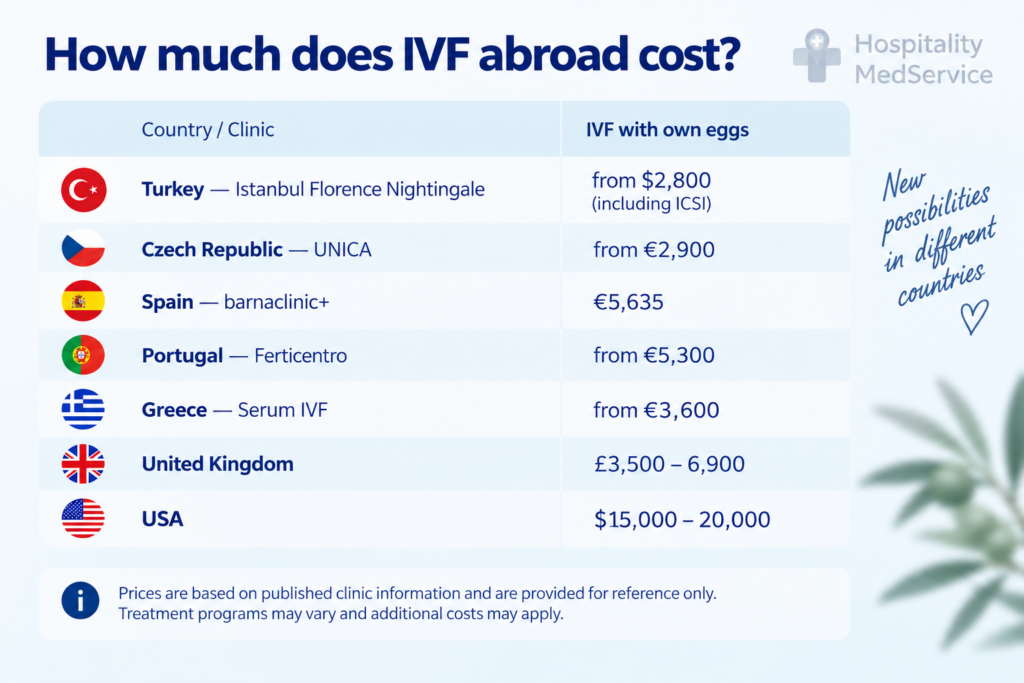
For Hospitality MedService patients, the main destinations are Czechia, Spain and Turkey. At UNICA in Czechia, IVF with your own eggs starts from €2,900. In Spain, the programme at Barnaclinic+ starts higher, at €5,635, with genetic testing of embryos and frozen embryo transfer billed separately. In Turkey, Istanbul Florence Nightingale offers an IVF with ICSI package from $2,800.
For comparison, private IVF in the UK typically costs around £3,500-6,900 per base cycle, while ASRM puts the average US cycle at roughly $15,000-20,000.
These figures aren’t a direct like-for-like comparison — package contents and included procedures differ between clinics. Before starting treatment, get an individual plan with the full programme cost from the clinic, and confirm separately what’s billed as an extra.
| Country | IVF With Own Eggs |
| Czechia | from €2,900 |
| Spain | €5,635 |
| Turkey | from $2,800 |
| Portugal | from €5,300 |
| Greece | from €3,600 |
| UK | £3,500-6,900 |
| USA | $15,000-20,000 |
Prices are approximate and subject to change. Programme contents vary between clinics, so the final budget needs to be calculated individually.
How IVF Abroad Works
The medical protocol itself doesn’t change just because a patient crosses a border — what changes is the logistics. Treatment can take a single trip, or stretch across two, depending on the patient’s health and the doctor’s recommendations.
The short protocol is the standard sequence: ovarian stimulation, egg retrieval, fertilisation, and embryo transfer in the same cycle, usually 3-5 days after retrieval.
The long protocol adds a step between retrieval and transfer. Instead of a fresh transfer, embryos may be vitrified (frozen) and the transfer scheduled for a later cycle. This happens in a few situations: when preimplantation genetic testing (PGT) is recommended, embryos are frozen while results are pending; when a doctor recommends a hysteroscopy — an exam of the uterine cavity that can reveal polyps, adhesions or other issues that might affect implantation; or when there’s a risk of ovarian hyperstimulation syndrome, making a transfer in the stimulated cycle inadvisable.
Before You Travel
Gathering medical records, choosing a country and clinic, a remote consultation with a reproductive specialist, a preliminary treatment plan, confirming which tests can be done at home, and a cost and travel estimate.
During Treatment
Some monitoring can sometimes be done from your home country, but egg retrieval and embryo transfer require being there in person. Dates and length of stay should be confirmed in advance.
After Treatment
Follow-up continues at home under your doctor’s guidance. It’s worth finding out in advance how the clinic manages remote follow-up and who to contact with questions.
It’s also worth arranging a local doctor to monitor you after you return. The Hospitality MedService team handles the transfer of medical records and coordinates contact between doctors where needed.
How to Choose a Clinic for IVF Abroad
How to Choose a Country for IVF
Price and the doctor’s reputation shouldn’t be the first thing you look at. Start by confirming that the country allows the programme you need, and that the clinic can treat your specific situation — donor material, or single-patient status, for example.
Next, look at the reproductive specialist’s relevant experience — particularly important if you’re over 40, have diminished ovarian reserve, or have had unsuccessful IVF before.
Only after that should you compare cost and logistics: what’s included in the programme, how many trips you’ll need, which procedures are billed separately, and how follow-up care after you return home is organised.
It’s also worth checking the clinic and lab’s accreditation. And be cautious comparing “success rates” across clinics without understanding the methodology — a rate might reflect pregnancy, implantation, or live birth per embryo transfer, and these are not the same thing. It’s also worth checking the accreditation of both the clinic and its laboratory. Which certificates and rankings genuinely reflect quality is covered in our article on how ratings and awards influence the choice of a clinic.
What Are the Risks of IVF Abroad?
Treatment abroad can be safe and effective, but it requires attention to legal and logistical details. HFEA recommends finding out in advance how fertility treatment is regulated in the destination country, who oversees the clinic and lab, how success rates are calculated, how many trips you’ll need, and how embryos will be stored. The UK regulator is explicit that its authority doesn’t extend to clinics abroad — so in a dispute, it won’t be able to step in.
The most exposed areas: the full cost of treatment is often higher than the first figure you see online, donor programmes differ in screening and the donor’s legal status, and how complaints are handled abroad is usually nothing like the process at home.
These and other common planning pitfalls are covered in detail in “Top 5 Mistakes When Planning Treatment Abroad: How to Avoid Them?“.
How Hospitality MedService Helps Arrange IVF Abroad
Choosing an IVF programme abroad takes a careful, joined-up approach.

Hospitality MedService reviews your medical records and treatment history, identifies the right country, clinic and doctor, arranges remote communication with the medical centre, requests a preliminary treatment plan and cost estimate, helps coordinate any required tests, and manages the trip itself.
HMS doesn’t make decisions about medical suitability and doesn’t guarantee treatment outcomes — the choice of method stays with the treating doctor, based on their assessment of your case.
IVF Clinics in Spain, Czechia and Turkey
Spain — Barcelona
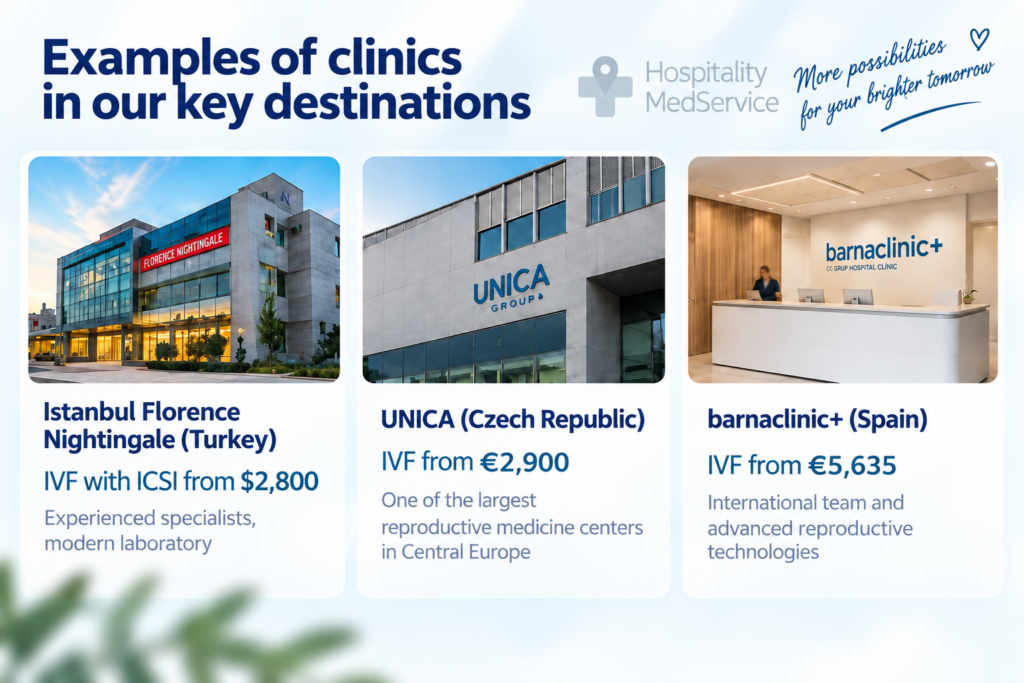
Barnaclinic+ runs a dedicated fertility unit, fivclinic+. According to the clinic, success rates exceed 55% for IVF with a patient’s own eggs and around 80% with donor eggs — figures worth reading with the calculation method and individual patient factors in mind, not as a guaranteed outcome. The unit is led by Dr. Dolors Manau Trullas, head of reproductive medicine at Hospital Clínic de Barcelona, whose focus includes ART, egg vitrification and freezing, and endometriosis treatment.
Quirónsalud Barcelona is another Barcelona option, with its ART department led by Dr. Ramon Aurell, who specialises in IVF, ICSI and assisted hatching.
Czechia — Prague
UNICA, a fertility clinic in Prague, with doctors Jan Lácheta and Ondřej Bačík.
Czech law requires treatment for a couple — a woman and a man — so UNICA isn’t a universal option for single women, but it’s a strong choice for couples looking for IVF or donor treatment.
Turkey — Istanbul
Istanbul Florence Nightingale is one option for patients considering IVF in Turkey. Dr. Nuri Delikara practises there — a specialist in assisted reproductive technology with many years’ experience in fertility and IVF. He holds an ART certificate from Hacettepe University, is a member of ASRM and ESHRE, and has published research in reproductive medicine.
One notable strength is the combination of clinical practice and research. A study of 3,017 ICSI cycles at the Kadıköy Florence Nightingale IVF Centre found an overall clinical pregnancy rate of 29.9%, and identified meaningful differences in outcomes between individual clinicians. Dr. Delikara is listed among the study’s co-authors.
What to Check Before IVF Treatment Abroad
Before you travel, it’s worth getting answers to a few questions:
- Do you qualify for the treatment you need in your chosen country, and does the clinic accept your patient category?
- Is the donor programme you need actually available there?
- How is donor anonymity or identification handled?
- What’s included in the price, and what’s billed separately?
- How many trips will you realistically need?
- Which tests and exams can you complete at home?
- How are embryos stored?
- Who will monitor you after you return?
- Who do you contact if treatment is delayed or something goes wrong?
Getting these answers up front helps you plan the details of treatment properly, with no unpleasant surprises.
Frequently Asked Questions
Legal restrictions, insufficient public funding, high private-treatment costs, waiting lists, age criteria, and unavailable donor programmes. For some patients, it’s also a way to access a wider choice of clinics and doctors.
Often, yes — if your chosen country allows the treatment you need and you meet its requirements. Check both the national law and the specific clinic’s rules, especially for donor programmes, single-patient status, or same-sex couples.
Yes, in a number of European countries. Donor sperm is available to single women in 37 countries, and donor eggs in 31, according to the European Atlas 2024. But not everywhere — Czechia, for instance, legally requires treatment for a couple, and that doesn’t change no matter which clinic you choose.
Donor programmes are available in countries including Spain and Czechia. Conditions differ, though — age, marital status, medical indications and donation rules all vary by country.
Yes — it’s available more widely than donor eggs, though access, screening and donor-identification rules still vary by country.
There’s no single price — the total depends on the protocol, medication, ICSI, donor programme, add-on procedures, and number of trips. ASRM puts a base US cycle at $15,000-20,000; starting prices at individual European clinics can be considerably lower, but they aren’t directly comparable without knowing exactly what’s included.
It depends on the country, clinic and programme. Among Hospitality MedService’s destinations, IVF with your own eggs starts from around $2,800 in Turkey (including ICSI) and from €2,900 in Czechia.
Often, but not always. Add medication, tests, extra procedures, flights and accommodation to the clinical package price before comparing totals.
There’s no one country that suits every patient. It depends on age, marital status, whether donor material is needed, donor requirements, budget and how many trips you can manage. Start with the legal and medical criteria that apply to you, then compare the countries and clinics that fit.
In many cases, yes — some tests and monitoring can be done at home, while egg retrieval and embryo transfer happen at the clinic. Confirm the exact plan before starting treatment.
Hospitality MedService can also arrange IVF in Italy, France, Germany, Switzerland, China, South Korea, Singapore and India, alongside Czechia, Spain and Turkey — though the options and legal conditions differ by country. Italy, for example, has an active reproductive-medicine and genetics sector; South Korea combines modern ART with strong embryology capabilities, and Asan Medical Center reportedly performs over 600 IVF cycles a year.
The right country depends on your specific situation — your own or donor material, age, medical indications, genetic testing needs and legal requirements — so HMS matches patients to a specific clinic and doctor, not just a country.
We help choose the country, clinic and doctor, coordinate communication with the medical centre, assist with paperwork and a preliminary cost estimate, arrange any required tests, and manage the trip.
Sources
- HFEA — Fertility treatment 2024: trends and figures: hfea.gov.uk/about-us/publications/research-and-data/fertility-treatment-2024-trends-and-figures
- HFEA — Fertility treatment abroad: hfea.gov.uk/treatments/explore-all-treatments/fertility-treatment-abroad
- CDC — ART Surveillance: cdc.gov/art/php/surveillance
- Fertility Europe / EPF — European Atlas of Fertility Treatment Policies 2024: fertilityeurope.eu/atlas2024
- ESHRE — ART fact sheet: eshre.eu/-/media/sitecore-files/Press-room/ESHRE_ARTFactSheet_v10_2025.pdf
- ASRM — Cross-border reproductive care: an Ethics Committee opinion (2022): asrm.org/practice-guidance/ethics-opinions/cross-border-reproductive-care-an-ethics-committee-opinion-2022
- Shenfield F. et al. — Cross border reproductive care in six European countries, Human Reproduction, 2010: pubmed.ncbi.nlm.nih.gov/20348165
Hospitality Medservice: Your Trusted Partner in Finding the Best Clinics Worldwide. Our website features only reputable medical institutions equipped with the latest treatment protocols and technologies. Compare clinics, meet doctors, and review treatment costs. Contact us for assistance with:
- Arranging treatment trips
- In-person appointments
- Video consultations
- Obtaining a “second opinion”
Submit a request on our website, and our medical coordinator will contact you promptly.
Leave a request for a free consultation.
A coordinator will contact you as soon as possible

Text reviewed

Read also:
*Illustrations in this article are created using artificial intelligence and are for illustrative purposes only. These images are not photographs of specific clinics, doctors, or patients, but are used to visually represent the procedures and treatment areas described.